

How to Read Batch Codes and Labels: Verifying Makeup Like a Pro
Why It Matters:
Batch codes are the DNA of makeup.
They tell you when a product was made, where it rolled off the line, and—most importantly—whether it’s the real deal or a red-flag fake.
If you’re building a vault, protecting your glam, or just buying smart, learning to read these tiny codes is one of the most powerful collector skills you can have.
✔️ What is a Batch Code?
A batch code is a combination of letters and numbers printed or stamped onto a product or its box.
It tells you:✔️ The production month
✔️ The production year
✔️ The manufacturing batch
✔️ Sometimes the factory or location
You'll usually find batch codes on the bottom, side, or crimp of the packaging.
Real products always have batch codes.
Fakes often don’t—or they slap on a sticker pretending to be one.
How to Read M·A·C Batch Codes:
M·A·C uses a simple, predictable format:
Example:
A43
Breakdown:
A = The batch (A = first run, B = second run, etc.)
4 = Production month (1 = January 2 = February… 0 = October)
3 = Production year (3 = 2013, 4 = 2014, 5 = 2015, etc.)
A43 = April 2013, first batch.
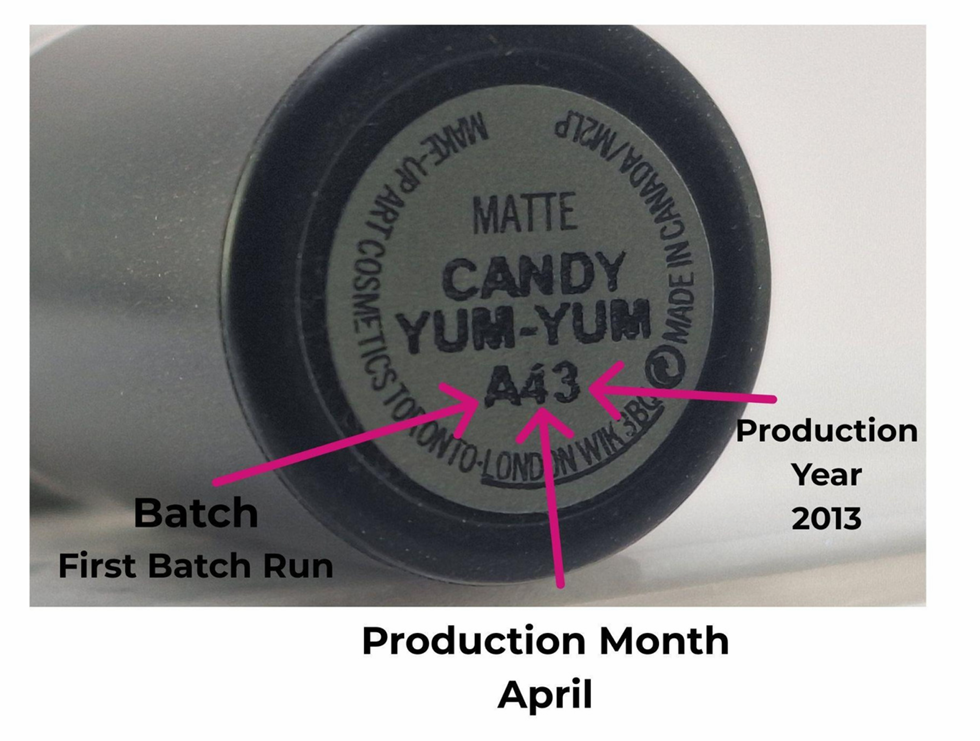
Quick M·A·C Batch Code Tips:
Codes repeat every 10 years (so “7” could be 2007 or 2017—use context).
Compare batch codes to known release dates when authenticating.
Limited editions sometimes use special or nonstandard codes—cross-check them.
Packaging Clues: The Things Fakes Cannot Hide
No matter how good a counterfeit looks, packaging always gives it away.
Look for:
Clean fonts, clean spacing — M·A·C uses crisp printing
Centered batch codes — not crooked or blurry
High-quality crimp printing — no ink bleed
Box integrity — fakes often use soft cardboard or dull ink
Correct ingredients list — fakes frequently omit key items
Weight & feel — legit M·A·C compacts and bullets feel solid
If anything feels “off,” trust your instincts. Real packaging has intention and precision.
⭐ Step-By-Step: How to Verify Makeup Like a Pro
Use this every time you authenticate a product—new, used, vintage, whatever.
1. Find the batch code
Check the box, bottom, or crimp
Make sure it’s printed, not stickered
2. Decode the batch code
Check month + year
Make sure it aligns with the collection’s known release window
3. Compare packaging
Look at fonts
Look at spacing
Look at box construction
Compare with your known-authentic items or Google Images from launch day
4. Check the label layout
Ingredients, weight, placement, wording, finish… fakes never get everything right
5. Smell & texture test (optional when safe)
Weird chemical smell?
Too oily, too dry, or too soft?
These are immediate “nope” signs.
6. Trust your gut
If the price is suspiciously low, or the seller feels shady, or the vibe is wrong?
Walk away.
⭐ Real vs. Fake Quick Checklist
✔️ Code matches the collection timeline
✔️ High-quality, centered printing
✔️ Correct font, spacing, and ingredient layout
✔️ No spelling mistakes or blurry edges
✔️ Weight + feel match authentic pieces
✔️ Seller has strong proof of origin
✔️ Price makes sense (collector items are not $12)
If even one of these feels wrong, proceed with caution.
If two or more feel wrong?
It’s a fake.
⭐ Sparkle Society XO Real Talk
Your instincts don’t lie.
Counterfeits aren’t just a waste of money—they’re a hit to your health, your collection, and your legacy as a collector.
Learn the signs.
Learn the codes.
Protect your vault like the icon you are.
⭐ Want the full tools of the trade?
Download the free The Sparkle Society XO M·A·C Authentication Guide for real-vs-fake photo examples, label diagrams, hologram breakdowns, and everything you need to authenticate with confidence.